

Using Positive Reinforcement to Train and Support Your Cat
Training your cat using positive reinforcement means focusing on what you want your cat to do and rewarding those behaviors. This approach can improve behavior, reduce stress, and strengthen the bond between you and your cat.
Finding Your Cat’s Preferred Reward
Rewards are most effective when they are something your cat genuinely loves. Many people automatically reach for treats, but research shows that most cats may actually prefer something else. Many cats prefer some form of human social interaction, like gentle petting, social praise, or play. Because every cat is different, it is important not to assume what they want. Instead, try a simple “preference test” at the start of a training session:
- Pick a few possible rewards (for example: a lickable treat, a small crunchy treat, a feather toy, and gentle petting).
- Present these rewards one at a time in a calm, quiet space.
- Watch what your cat chooses or spends the most time interacting with.
If your cat keeps going back to the feather toy and mostly ignores the treats, the toy might be the best reward to use for that training session. On another day, your cat might be more interested in food than play. Preferences can change based on mood, how much your cat has eaten, or how much they have already played.
Timing is Everything
To help teach a behavior, the reward needs to come immediately after your cat performs the behavior. For example, if you want to reward your cat for sitting, the reward should happen as soon as your cat sits. If there is a delay, your cat may not know which behavior is being rewarded. When you cannot give the reward immediately (for example, your hands are full, or you need to reach for the treat), you can use a training tool such as a conditioned reinforcer (see below) to “mark” the moment and then give the reward a second or two later.
When Not to TrainFor training to be kind and effective:
Each cat learns at their own pace. Some cats will pick up new behaviors quickly, while others will need more practice. As long as your cat is healthy and relaxed, it is okay if they are a slower learner — training can still be very beneficial. |
Positive Reinforcement Techniques for Training
Conditioned Reinforcers
A conditioned reinforcer is a signal you pair with a reward so that, over time, the signal itself tells the cat, “You did it right, a reward is coming!” Common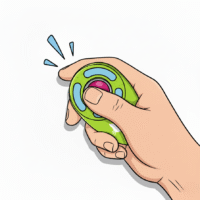 examples are:
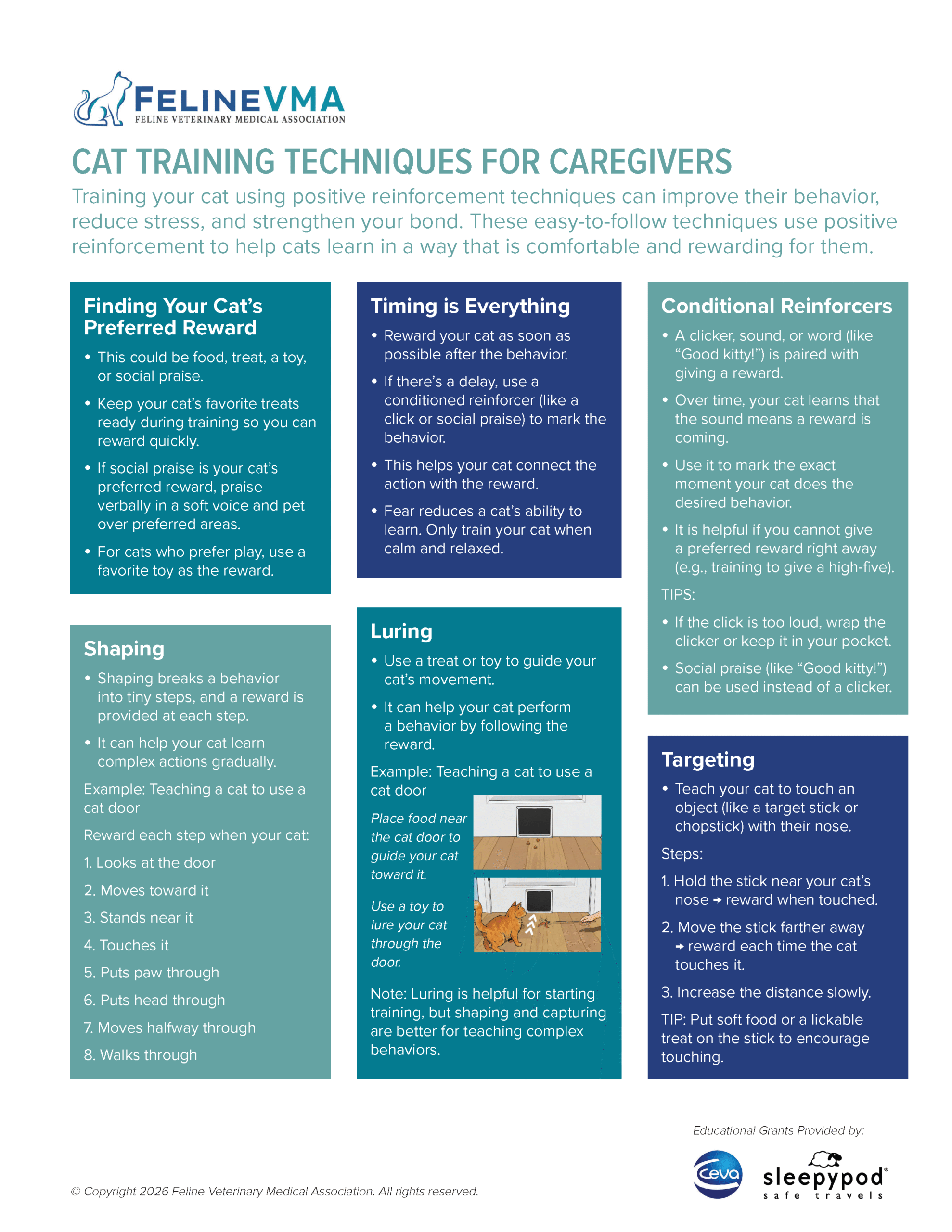
- A “click” sound from a clicker or pen.
- A short phrase, such as “Good kitty!”
- A hand signal or visual cue (especially helpful for deaf cats or sound-sensitive cats).
How Conditioned Reinforcers Work
- You pair the new signal with a reward.
- Click, then immediately give a treat
- Say “Good kitty!” then immediately give your cat their favorite reward
- After many pairings, your cat starts to expect a reward each time they hear or see that signal.
- Now you can use the signal to mark the exact moment your cat does the behavior you want, and then follow with the reward as soon as possible.
This is especially helpful when:

- You need a moment to get the treat ready, but do not want to miss the correct behavior.
- You are teaching more complex behaviors (like a high-five or offering a paw).
If the clicker seems too loud for your cat:
- Soften the sound by keeping it in your pocket or wrapping it in cloth.
- Try soft verbal praise (“Good kitty!”) instead of a click.
- For sound-sensitive or deaf cats, use a hand signal or gentle visual cue.
Shaping
Shaping breaks a complex behavior into small steps and rewards your cat for each step along the way. Using this approach helps your cat learn gradually and can reduce frustration for both of you.
How Shaping Works
Think of shaping as climbing a staircase: Each step brings your cat closer to the final behavior.
Example: Teaching a cat to use a cat door.
You might reward your cat when they:
- Look at the cat door.
- Take a step toward the door.
- Stand near the door.
- Touch the door with any part of their body.
- Put a paw through the door.
- Put their head through the door.
- Move halfway through.
- Walk all the way through the door.
Cats sometimes skip steps, and that is okay! Reward each step they take that brings them closer to the final behavior.
Luring
Luring uses your cat’s preferred treat, such as a food or a toy, to guide their movement. For example: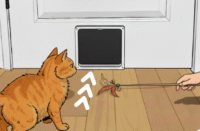
- Place a small bit of food on the floor and slowly move it toward the cat door to encourage your cat to walk over to it.
- If your cat prefers toys, use a feather wand or another favorite toy to lead them toward and through the door.
Once your cat has followed the lure and done the desired behavior (such as stepping through the door), praise and reward them with their preferred treat. However, because the behavior is being guided by you rather than your cat doing on their own, luring is usually less effective for complex behaviors than shaping or capturing.
Targeting
Targeting means teaching your cat to move toward and touch an object. A “target stick” is used for this technique. Examples of what you can use include:
- A commercial target stick.
- A pen with the cap on.
- A chopstick.
You can teach targeting through small shaping steps:
- Place the target just in front of your cat’s nose. Reward them when they touch it with their nose.
- Move the target a little farther away. Reward when they approach and touch it again.
- Gradually increase the distance. Reward every time your cat walks up and touches the target.
- Over time, your cat learns that touching the stick leads to something good.
Once your cat understands targeting, you can:
- Guide them into a carrier.
- Ask them to move to a specific spot (like a scale or mat) which is especially helpful during a veterinary checkup.
- Gently ask them to stand or change position.
| Tip: You can combine targeting and luring by putting a bit of soft food or lickable treat on the end of the target stick at first. This added treat encourages your cat to sniff and lick it, making it easier for them to understand that touching the target is what earns the reward. |
Capturing
Capturing means rewarding a behavior your cat is already doing naturally without targeting or luring. Think of some behaviors your cat already does:
- Sit
- Stretch
- Walk over to certain spots
- Lie down in favorite places
In capturing, watch your cat’s daily routine and ask yourself, “What behavior would I like to see more often?” For example, if you want your cat to sit politely before meals:
- Notice when your cat sits on their own while waiting for food.
- As soon as they sit, say “Good kitty!” and offer their preferred reward.
- Have treats or a toy nearby so you can respond quickly.
The more you reward the behavior as soon as it happens naturally, the more your cat will offer it. Capturing works well because the cat is voluntarily choosing the behavior, which makes learning long-lasting.
Putting Behaviors on Cue
Once your cat has learned how to do a behavior for rewards, you can add a cue so you can ask for it when you need it. Cues can be:
- A word (“Sit,” “Come,” “Up”).
- A hand signal or short gesture.
Steps for Adding a Cue
- Wait for your cat to perform the behavior (for example, sit).
- As your cat sits down fully, say the cue word (“Sit”) and then reward. Repeat several times.
- Next, say “Sit” just as you see your cat beginning to sit, before they are fully seated, and then reward. Repeat several times.
- Once your cat has made this connection, say “Sit” before they sit.
- When your cat sits in response to the cue, praise and reward your cat.
Over time, your cat learns that the cue is a signal to do the behavior, and you can use the cue to ask for that behavior in different situations.
Cooperative Care
Cooperative care means training your cat to willingly participate in their own care—both at home and at the veterinary practice. Examples of cooperative care skills include:
- Going into a carrier.
- Moving onto a scale or exam table.
- Offering a paw, leg, or tail (such as for a blood draw).
- Holding still briefly for an examination.
Cooperative care should only be done when your cat:
- Is healthy and not in pain.
- Is not showing fear-anxiety or other protective emotions.
Ask your veterinarian how to practice cooperative care at home so that visits and procedures are calmer and safer for everyone.
Improving Welfare
Positive reinforcement can be used for more than just manners or tricks—it can also help cats engage in their natural behaviors in healthy ways and reduce unwanted behaviors. A few examples include:
- Safe outdoor experiences:
- Training your cat to walk on a harness and leash.
- Teaching them to go in and out of a catio or secure outdoor enclosure through a cat door.
- Allowing them to sniff, explore, and scent mark safely.
- Scratching:
- Reinforce scratching on a scratching post by praising and rewarding your cat when they use it.
- The more you reward appropriate scratching, the more your cat will choose the scratching post instead of furniture.
- Problem solving and enrichment:
- Teaching new behaviors or games can give your cat mental challenges and reduce boredom.
- This kind of positive mental stimulation can lower stress and decrease behavior problems.